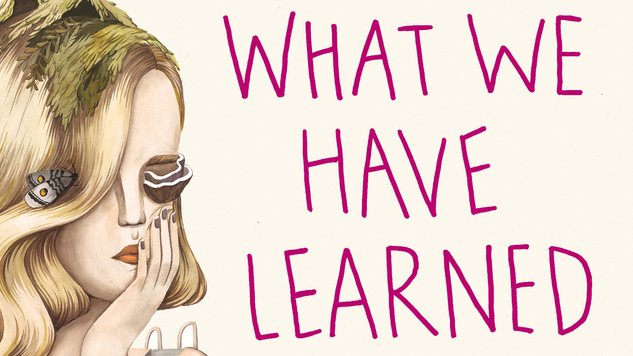
"Never judge a book by its cover." It's as much a rule about prejudice against people as it is about reading. Some books are only redeemed by their covers, for they lack in quality. That does not apply to Clare Beams's We Show What We Have Learned: and Other Stories. The nice thing about reviewing a Kindle sample for a short story collection is that the sample contains one, full story, so it won't be like a sample for a novel that only gives you the first chapter. The first story in the collection We Show... is "Hourglass." It orignally appeared in Willow Springs Magazine, a publication that's published the works of Aimee Bender and Marilynne Robinson - if you, reader, are familiar with these writers, that may give you some insight into what kind of story "Hourglass" is. The most I knew about the collection, and the reason I chose to sample it was that The New York Times Book Review began its review by saying "Several of the stories in Clare Beams’s debut collection are infused with a subtle form of magical realism," and I swear I read nothing more, not wanting to have anything influencing me beyond the writing.
"Hourglass" with it's concentration on a warped education, reminds me of Caitlin Horrocks This is Not Your City, specifically the short story "Zero Conditional." Beams tells the story of Melody, whom is a new student at the Gilchrist School. The Gilchrist School is marketed as a place that provides a "transformational education," and beyond the language of the beginning, "Hourglass" seems to be one of the stories that does not include magical realism. It is literary fiction in that Melody is a fan of "mysteries" and most of the scenes take place in Miss Caper's English class where Melody and her classmates are reading poems like Sun Tung P'o's "On a Painting by Wang the Clerk of Yeng Ling." Miss Caper reads the poem to the class and says with a sigh, "There is a deep, modest kind of beauty in the poem I have just read, girls. A beauty that stems from rendering a thing precisely and quie
tly in words." "Hourglass" achieves the same effect, for in quiet words, so much of Melody's transformation is not something intellectual, but superficial, as seen in the climax of the story; thus showing what she has learned, since all she learned is about fashion and beauty.
I assume from the title and "Hourglass" that a number of Beams's stories are about learning and transformation. Beams, a Pittsburgh writer, is a writer I think I will consider myself a fan of as soon as I read more of her work, so long as they are similar to "Hourglass" in their fanciful use of language and exhbit the same reverence for literature as "Hourglass."

No comments:
Post a Comment